In the following addition, replace every letter with a number. The same letter always represents the same digit, and no digit is represented by more than one letter.

You can check your solutions here
In the following addition, replace every letter with a number. The same letter always represents the same digit, and no digit is represented by more than one letter.
You can check your solutions here
Matchsticks problems usually fall into one of 2 categories: roman or digital numbers, or geometrical problems. This weeks puzzle is one which belongs to the geometrical group.

Add 8 matches to divide this square into 4 areas of equal size and shape. No matches may be broken or cross each other.
This problem is not my own, but i was recently reminded by it by a puzzle on dawies blog.
A new puzzle is posted every friday. You are welcome to comment on the puzzles. Solutions are added at the bottom of a puzzle after one or more weeks.
You can check your solutions here
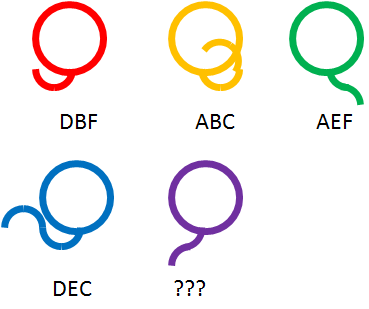 One of the type of puzzles taht has become a trademark of this blog are ‘coded patterns’
Which code goes to the question marks?
You can check your solution here
You are welcome to remark on the puzzle: its wording, style, level of difficulty. I love to read your solution times. Please do not spoil the fun for others by listing the solution. Solutions will be posted after one or more weeks.
In January 2014, I published a one puzzle blogpost on Letterboggle. Going through old notebooks, I discovered some more of these puzzles.
Let me restate the rules:
* All 26 letters of the alphabet have been used exactly once;
* two letters which are consecutive in the alphabet are always adjacent either horizontally, vertically or diagonally. Hence the alphabet forms a kind of snake throughout the firgure;
* The letter A does not need to be adjacent to the letter Z;
* A letter in the margin is present in the same row (if margin letter is adjacent to a row), in the same column (if the margin letter is on top or bottom of a column) or in the same diagonal (if the mnargin letter is in one of the corners);
Letterboggle (1)*

Letterboggle (2)*

Letterboggle (3)**

Note that not all border fields contain a clue. This is on purpose.
Personally I would find alphabet snake a better name, but
 A spy wanted to enter a castle, but this castle was guarded by a sentry. Only those who knew the password, were allowed to enter. The spy hid himself in the bushes near the guardhouse of the sentry, so that he could overhear the password.
The baker approached, and the sentry called:
‘If I say 12, what do you reply?’
‘6’
‘You may pass.’
The smith approached, and the sentry called:
‘If I say 6, what do you reply?’
‘3’
‘You may pass.’
The spy concluded: ‘I know enough’
With a long detour he went back, disguised himself as a grocer and approached the sentry. The sentry called:
‘If I say 4, what do you reply?’
‘2’
The spy was taken prisoner.
What should he have replied?
I would like to thank our daughter Margreet for passing on this nice problem, which she heard from Professor Jochem Thijs. Alas he did not reply to my question if he invented this puzzle or not. If he is not the inventor, and someone knows the original source, I would be grateful.
You can check your solution here
You are welcome to remark on the puzzle: its wording, style, level of difficulty. I love to read your solution times. Please do not spoil the fun for others by listing the solution.
The Russian scientist M.M. Bongard published a book in 1967 that contains 100 problems. Each problem consists of 12 small boxes: six boxes on the left and six on the right. Each of the six boxes on the left conform to a certain rule. Each and every box on the right contradicts this rule. Your task, of course, is to figure out the rule.

You can check your solutions here
You can find more Bongard problems at Harry Foundalis site, and I intend to publish more problems in the future.
A new puzzle is posted every friday. You are welcome to comment on the puzzles. Solutions are added at the bottom of a puzzle after one or more weeks.
Once a month, or once every other month, I try to take a more in depth look at a puzzle type. This month I want to have a look at the “spot the differences” puzzles. This is a pretty popular type of puzzle, Bing turns up at least 4 different websites and the google playstore has at least 10 apps. URLs of the websites are mentioned at the end of this article. The trigger for this post is my recent acquisition of a magazine “zoek de verschillen” (find the differences) by Denksport, the largest puzzle publisher in the Netherlands.
1) Spot the differences


Try to find all 15 differences!
(The picture has been taken in the Netherlands, in the tourist town of Vaals).
You can check your solutions here
While making this puzzle, trying my hand at some of the puzzles in the magazine, and browsing around on the web, I noticed there are several types of changes:
1 – an object appears in one image and not in the other. An example is a traffic sign that has an arrow in one image and no arrow in the other. The object often is small.
2 – the object is present in both images, but with different colors. For instance, if you have a dish with colorful sweets, one of the sweets has been changed from green to orange.
3 – the object is present in both images, but in one image it is longer, shorter, wider or narrower than in the other. In one of the puzzles in the web, I noticed a garbage can, attached to a pole, reached to the pavement on the left imgae while in the right image it was a foot above the pavement.
4 – the object is present in both images, and the object is identical in both images, but in a different spot. For example, that crow on the roof is sitting near one end of the roof or in the middle.
What makes a puzzle tough? Which differences are hard to spot? I could not find any scientific research on this topic. Generally, I’d say that small differences are harder to spot than big differences. But some differences seem to be ignored by the eye or mind, even though they are not particularly small. A change in a background is often harder to spot than one in the foreground. Changes to the top of an object seem to be spotted more easily than changes to the bottom.
2 identicals
A second format that the afore mentioned magazine applies is that of 6 copies, and you have to find the 2 identical copies.

|

|

|

|

|

|
The abundant availability of digital photos has greatly enhanced the possibility for everyone, both amateur and professional, to create these puzzles. I don’t have photoshop, but MS paint served me well during the creation of the puzzles above. Before the age of electronic manipulation, the images were often handdrawn. You can find one on the english language wikipedia.
You can check your solutions here
3) Subdivisions
A large photo is subidivided into small rectangles, with rows and column labelled. A few of the rectangles are copied below the photo and the puzzler has to find out which small rectangle they correspond with.


What are the coordinates of the two cut outs?
You can check your solutions here
4) Cutout
A rectangle is cut out from a photo and displayed below it. Several other sections are copied below the photo, and the puzzler has to find out which is the cut out which fits into the picture. The cut outs are tilted, and I currently lack the skills or tools to do this for you.
5) Links
Here are some of the links I found and which work:
* http://www.spotthedifference.com/ : spot 4 differences in a couple of images, allowing you to give up and try again later. Differences are both small and large
* http://spot-the-differences.com/: 5 differences, all well visible, timed.
* http://www.coolmath-games.com/0-spotthedifference2: timed, retry option. Alas flash seems required.
*
Don’t worry, this blog is not turning into a crosswords puzzle blog, and neither is it changing into a word puzzl;e blog.
But every now and then there is a nice variation on a traditional theme, and for programmers there is a nice variation using regexp here
In an upcoming post I intend to go into depth on numerical crossword variations,
For now: Have fun!
Yesterday, that is, the day before I wrote this, I received the English translation of Boris Kordemsky’s “Russian Puzzles” (Matematicheskaia smekalka, which translates as ‘Math savvy’), edited by Martin Gardner. It was first published in 1956. In the first few chapters it contains many old chestnuts, sometimes disguised in a new coat. Though I am not a big fan of Martin Gardner, he did preserve the Russian atmosphere well. Many of the familiar puzzles can also be found in the works of Henry Dudeney and Sam Loyd. Alas Martin Gardner left out a series of problems towards the end related to number theory (‘too difficult for the american public’). Now that that sounds like two insults :).
 It inspired me to make a small variation:
“I will plough this field at an average of 200 furrows a day,” Pjotr told his comrades in the Kolkhoz. And indeed he started out right away the next day. He set off relaxed; making just 100 furrows a day on the first 1/3 of the field , but he could blame some initial problems for thet. Once the initial problems were solved, he was able to plough at a speed of 200 furrows a day for the middle 1/3 of the field.
He realized that he was still lagging behind on his promise and made some small improvements, enabling him to complete the final third of the field at 300 furrows a day. At the next meeting of the kolkhoz he told with satisfaction that he had lived up to his promise. The party administrator however denied his claim:
“Tovarisj Pjotr,” he said, “I think you err.”
Who was right?
You can check your solutions here
A new puzzle is posted every Friday. You are welcome to comment on the puzzles. Solutions are added at the bottom of a puzzle after one or more weeks.


 justpuzzles